Live JS & Secret Auditing
Detects vulnerable bundles, third-party scripts, and leaked API keys directly in production over HTTPS.
Continuous security and uptime monitoring for live web apps, with zero agents.
Setup in 60 seconds • Zero repo or server access • 100% EU-hosted
Run a free instant check on any public URL to spot exposed versions, missing security headers, and certificate risks.
Protect every web app, portal, and marketing site without touching build pipelines or waiting on InfoSec approvals.
60-second setup
Enter your public web apps, portals, and marketing domains. No server agents, plugins, or GitHub tokens.
100+ security & health checks
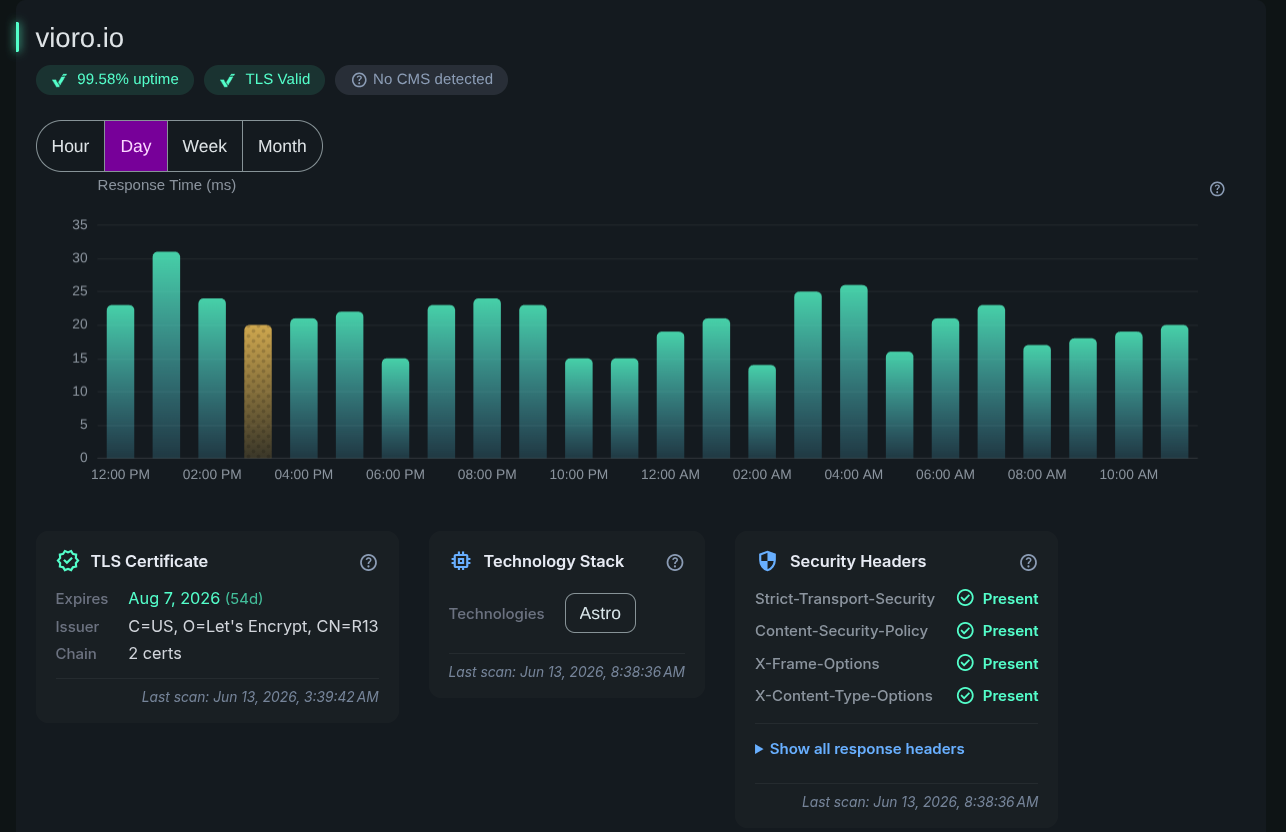
Vioro checks uptime, live JavaScript and CMS versions, leaked API keys, TLS certificates, and HTTP security headers around the clock.
Zero-noise alerts
Get severity-ranked alerts the moment a known vulnerability hits your live site, an API key leaks, or TLS nears expiry.
Vioro's November 2026 scan of nearly 200,000 public websites shows what passes code checks is not always what runs in visitors' browsers.
Nearly 1 in 2 websites serve known vulnerable JavaScript
2 in 3 on their own domain, 1 in 3 via CDN links & external tags.
Half of live libraries stay invisible without deep browser-code inspection
Everything needed to keep live web apps and sites online, hardened, and audit-ready from one European platform.
Detects vulnerable bundles, third-party scripts, and leaked API keys directly in production over HTTPS.
Monitors TLS expiry, HTTP security headers, cookies, and WordPress, Drupal, and other CMS platforms with zero plugins.
Tracks multi-vantage availability and builds a live software inventory from public responses without repo tokens.
One shared view of production health without slowing down shipping.
Catch stalled TLS renewals, missing HTTP headers, stale CDN scripts, and downtime from one dashboard.
Spot vulnerable live scripts and leaked API keys in production without maintaining code plugins.
Support NIS2 external security controls on 100% EU infrastructure with zero code access.
Setup takes under 60 seconds. Create an account, enter your website addresses, and Vioro starts monitoring your live site immediately with a 14-day free trial.
No. Vioro checks your public website from the outside just like a visitor's browser, so you never need server agents, website plugins, or access to your source code.
Downtime alerts only fire after 3 failed checks in a row, and security alerts focus strictly on real issues affecting your live site: known security flaws, exposed keys, and expiring security certificates.
Vioro runs on 100% European-owned servers within the EU for strict data privacy, while monitoring websites hosted anywhere in the world. Review our Security & Trust overview for details.
You get full access to continuous uptime, live script security, exposed key, certificate, and security setting checks for your domains with no credit card required to start.
Stay updated with our latest articles, guides, and website security analysis.
We scanned 196,347 public websites and found 46% serve known vulnerable JavaScript. Explore why patched Git repos still leak API keys, stale bundles, and unguarded external scripts.
Read Article →Understand why Vioro requires domain ownership verification before unlocking deeper security findings for a site, and how this prevents the platform from being abused for reconnaissance.
Read Article →Explore the critical cybersecurity blind spot between git manifests (package.json / package-lock.json) and production browser execution. Why security fixes lag in CDNs and why outside-in JS detection changes the game.
Read Article →How we built outside-in WordPress version and plugin vulnerability detection mapped to real-time CVEs without asking you to install any security plugins.
Read Article →Learn how to create maintainable software docs using Architecture Decision Records (ADRs) with editable SVG diagrams that live inside your version control.
Read Article →Add your domains in under 60 seconds and get continuous visibility into live vulnerabilities, leaked API keys, TLS health, and uptime.