100+ Automated Security & Health Checks

Every outside-in check Vioro runs on live websites, web applications, and CMS platforms over public HTTPS. No server agents, no build plugins, and no repository tokens required.

  • Outside-in over public HTTPS
  • 100% EU-hosted infrastructure
  • 24/7 continuous advisory watch

Catalog entries group related automated probes by risk area, while uptime and monitoring intervals follow your plan tier.

Live JavaScript, Libraries & Secrets

Inspects compiled production bundles, code-split chunks, inline scripts, and external script tags over public HTTPS with no server agents or repository tokens required.

Severity: Info Cadence: Every Scan

Bundled & Standalone Library Fingerprinting

Identifies exact library versions across 5,000+ npm packages and 250,000+ releases inside Vite, Webpack, Rollup, Next.js, Angular, and Vue bundles as well as standalone script tags using structural code fingerprinting.

Vulnerable libraries guide
Severity: High Cadence: 24/7 Watch

Continuous Vulnerability Advisory Matching

Correlates live browser libraries against 230,000+ published security advisories around the clock, separating confirmed vulnerable releases from broader version-range warnings.

Severity: Medium Cadence: Every Scan

Multi-Version Library Coexistence Detection

Detects when a live page ships multiple conflicting versions of the same JavaScript library at once, such as an updated app bundle paired with an older third-party widget.

Severity: Medium Cadence: Every Scan

Exposed Production Source Map References (.js.map)

Flags external sourceMappingURL directives in production scripts that point browsers to external .js.map source map files.

Severity: Critical Cadence: Every Scan

Cloud, Payment & AI Credential Leak Detection

Scans inline and external browser scripts for exposed vendor credentials (AWS, Stripe live keys, OpenAI, Anthropic, GitHub, GitLab, npm, Slack, SendGrid, Google Cloud, and privileged PostHog tokens), masking secret values immediately so raw credentials are never stored in our infrastructure.

Severity: Critical Cadence: Every Scan

Private Keys, Database URIs & Hardcoded Tokens

Detects plaintext private keys, PostgreSQL/MySQL/MongoDB/Redis connection URIs with embedded passwords, hardcoded HTTP Bearer auth tokens, and hardcoded secret assignments.

Severity: Medium Cadence: Every Scan

Third-Party Script Origin & Subresource Integrity

Classifies first-party, same-organization CDN, and third-party script hosts while checking whether external script tags enforce Subresource Integrity attributes.

HTTP Security Headers & Cookies

Audits browser-enforced response headers and Set-Cookie transport attributes on every HTTPS landing-page response.

Severity: Medium Cadence: Every Scan

Missing Strict-Transport-Security (HSTS)

Verifies that HTTPS responses return a Strict-Transport-Security header so browsers refuse unencrypted downgrades on subsequent visits.

HSTS configuration guide
Severity: Low Cadence: Every Scan

Short or Weak HSTS max-age

Flags Strict-Transport-Security policies whose max-age lifetime falls below the recommended 180-day baseline.

Severity: Low Cadence: Every Scan

Invalid HSTS Preload Configuration

Checks that headers declaring the preload directive also satisfy includeSubDomains and at least a 365-day max-age.

Severity: Low Cadence: Every Scan

Missing Content-Security-Policy (CSP)

Detects HTTPS pages served without an enforcing Content-Security-Policy header to restrict script and resource origins.

CSP implementation guide
Severity: Low Cadence: Every Scan

Weak or Report-Only Content-Security-Policy

Flags CSP rules that remain in Report-Only mode, omit script-src/default-src directives, use wildcard origins, or allow unsafe-inline or unsafe-eval execution.

Severity: Low Cadence: Every Scan

Clickjacking Defense (X-Frame-Options & frame-ancestors)

Verifies that either CSP frame-ancestors or X-Frame-Options (DENY or SAMEORIGIN) prevents unauthorized framing of login or checkout flows.

Clickjacking protection guide
Severity: Low Cadence: Every Scan

MIME-Sniffing Protection (X-Content-Type-Options)

Checks that X-Content-Type-Options is set to nosniff so browsers do not reinterpret uploaded files as executable scripts.

Severity: Low Cadence: Every Scan

Referrer-Policy & Permissions-Policy Hygiene

Audits missing or overly permissive Referrer-Policy directives and flags wildcard Permissions-Policy grants on sensitive browser APIs.

Referrer & Permissions guide
Severity: Info Cadence: Every Scan

Server & Runtime Version Banner Disclosure

Identifies Server and X-Powered-By response headers that reveal exact web server or runtime version numbers.

Severity: Medium Cadence: Every Scan

Insecure Cookie Transport Flags

Flags Set-Cookie headers served over HTTPS without the Secure flag, as well as SameSite=None, __Secure-, and __Host- cookies missing Secure.

Cookie security flags guide

TLS Certificates & Transport Hygiene

Validates port-443 TLS certificates, protocol negotiation, HTTP-to-HTTPS redirect chains, canonical hosts, and mixed-content references.

Severity: High Cadence: Daily

Graduated TLS Certificate Expiry Warnings

Checks HTTPS certificate validity daily and sends advance expiration reminders at 30, 14, 7, and 1 day before expiry.

Certificate types & renewals
Severity: Critical Cadence: Daily

Certificate Chain, Hostname & Issuer Validation

Verifies the presented certificate and intermediate trust chain against trusted root authorities, detecting expired certs, hostname mismatches, and untrusted issuers.

Severity: Info Cadence: Every Scan

TLS Protocol Version Inspection

Verifies modern TLS 1.2 and TLS 1.3 handshake negotiation on port 443 and inspects covered hostnames and certificate issuer details.

TLS versions guide
Severity: High Cadence: Every Scan

Active Mixed Content (Scripts, Iframes, Stylesheets)

Inspects rendered HTTPS pages for script, iframe, link, embed, and object elements loaded over plain HTTP that browsers block outright.

Fixing mixed content
Severity: Medium Cadence: Every Scan

Passive Mixed Content (Images, Audio, Video)

Flags img, audio, video, source, and track assets referencing cleartext HTTP URLs on HTTPS pages.

Severity: Medium Cadence: Every Scan

Insecure Internal Links & Form Actions

Finds internal hyperlinks and HTML form action targets pointing to plain HTTP URLs on the same domain or subdomain.

Severity: Medium Cadence: Every Scan

Missing or Temporary HTTP-to-HTTPS Redirects

Verifies that port-80 HTTP requests upgrade to HTTPS using permanent 301 or 308 redirects rather than staying on HTTP or using temporary 302/307 codes.

Redirect hygiene guide
Severity: High Cadence: Every Scan

HTTPS Downgrades & HTTP Redirects Without HSTS

Detects redirect hops that downgrade HTTPS requests back to cleartext HTTP and flags sites relying on HTTP-to-HTTPS redirects without an HSTS header.

Severity: Low Cadence: Every Scan

Excessive Redirect Chains & Root-to-Subpath Redirects

Measures redirect hop counts that add latency and flags domain roots redirecting visitors into unexpected subpaths.

Severity: Medium Cadence: Every Scan

Apex vs. www Canonicalization & Reachability

Checks whether apex and www hostnames resolve consistently to the same canonical host or leave one variant unreachable or serving split content.

CMS & WordPress Exposure

Performs outside-in platform fingerprinting across WordPress, Drupal, Joomla, and TYPO3 alongside non-intrusive WordPress exposure probes.

Severity: High Cadence: Every Scan

WordPress, Drupal, Joomla & TYPO3 Version Fingerprinting

Identifies WordPress, Drupal, Joomla, and TYPO3 versions externally from public assets, plus WordPress plugin and theme detection matched against published security advisories, without admin credentials or CMS plugins.

WordPress hardening guide
Severity: Critical Cadence: Every Scan

Exposed wp-config Backup Copies

Probes for leftover wp-config.php.bak, .txt, .old, and ~ backup files that can leak database credentials in plain text.

Severity: Critical Cadence: Every Scan

Publicly Accessible WordPress debug.log

Checks whether /wp-content/debug.log is readable over public HTTPS, preventing stack traces and internal paths from leaking.

Severity: Critical Cadence: Every Scan

Accessible WordPress install.php

Verifies that /wp-admin/install.php requires authentication or returns a blocked response instead of exposing installer state.

Severity: High Cadence: Every Scan

Exposed xmlrpc.php Endpoint

Detects publicly reachable /xmlrpc.php endpoints commonly targeted for credential brute-forcing and amplification abuse.

Severity: High Cadence: Every Scan

REST API & Author-Scan User Enumeration

Tests whether /?rest_route=/wp/v2/users or /?author=1 exposes registered WordPress usernames to unauthenticated visitors.

Severity: Medium Cadence: Every Scan

Open Directory Listings on /plugins/ & /uploads/

Checks /wp-content/plugins/ and /wp-content/uploads/ for web server index pages that list every installed asset publicly.

Severity: Medium Cadence: Every Scan

Exposed readme.html & Root Backup Archives

Flags accessible /readme.html version files and leftover /backup.sql, /backup.zip, or /wp-content/backup.sql archives.

DNS & Email Authentication

Audits public DNS records, email anti-spoofing policies, certificate issuance guardrails, and network hosting metadata.

Severity: High Cadence: Every Scan

Insecure SPF +all Policy

Detects SPF TXT records terminating in +all or bare all, which authorize any internet host to send email pretending to be your domain.

Severity: Medium Cadence: Every Scan

Broken SPF Records (permerror)

Flags multiple v=spf1 records for the same domain, recursive self-includes, and top-level records exceeding the 10-DNS-lookup limit.

Severity: Low Cadence: Every Scan

DMARC Monitoring Without Aggregate Reporting (rua=)

Identifies domains set to DMARC p=none without a rua= aggregate reporting URI, leaving spoofed email attempts both unblocked and invisible.

Severity: Low Cadence: Every Scan

BIMI (Brand Logo) Record Without Enforced DMARC

Flags default._bimi brand indicator records ignored by mailbox providers because DMARC is not enforced at p=quarantine or p=reject.

Severity: Medium Cadence: Every Scan

Weak DKIM Public Keys & Test Mode

Checks discovered mail-signing selectors for weak DKIM keys, short key lengths, or leftover test-mode flags.

Severity: High Cadence: Every Scan

Dangling DKIM CNAME Takeover Risk

Detects _domainkey CNAME delegations pointing to unprovisioned or decommissioned third-party email targets.

Severity: Info Cadence: Every Scan

CAA Records, Nameservers, Hosting Network & WHOIS Privacy

Verifies CAA certificate issuance records, MX and authoritative nameservers, IPv4/IPv6 hosting network providers, registrar state, and WHOIS privacy protection.

Well-Known Files & Crawler Posture

Audits public crawler directives, security disclosure files, and bot or WAF challenge responses while strictly honoring robots.txt rules.

Severity: Low Cadence: Every Scan

robots.txt Sensitive Path Disclosure & AI-Crawler Rules

Inspects /robots.txt for Disallow rules that reveal internal admin, backup, or staging paths, while recording Crawl-delay and AI-crawler directives.

Severity: Low Cadence: Every Scan

Security Disclosure Policy (/.well-known/security.txt)

Checks whether security.txt is served over HTTPS at /.well-known/security.txt with valid Contact URIs, valid expiration dates, and PGP canonical links.

Severity: Info Cadence: Every Scan

Bot Protection, WAF & Challenge Detection

Detects bot protection challenges (WAF / CAPTCHA challenge) and aggressive request delays that limit outside-in visibility, reporting exact header or rule attribution.

Allowing VioroBot cleanly
Severity: Info Cadence: Every Scan

/llms.txt & /humans.txt Policy File Verification

Verifies whether /llms.txt and /humans.txt return genuine plain-text policy documents rather than HTML single-page app fallback errors.

Uptime & Availability

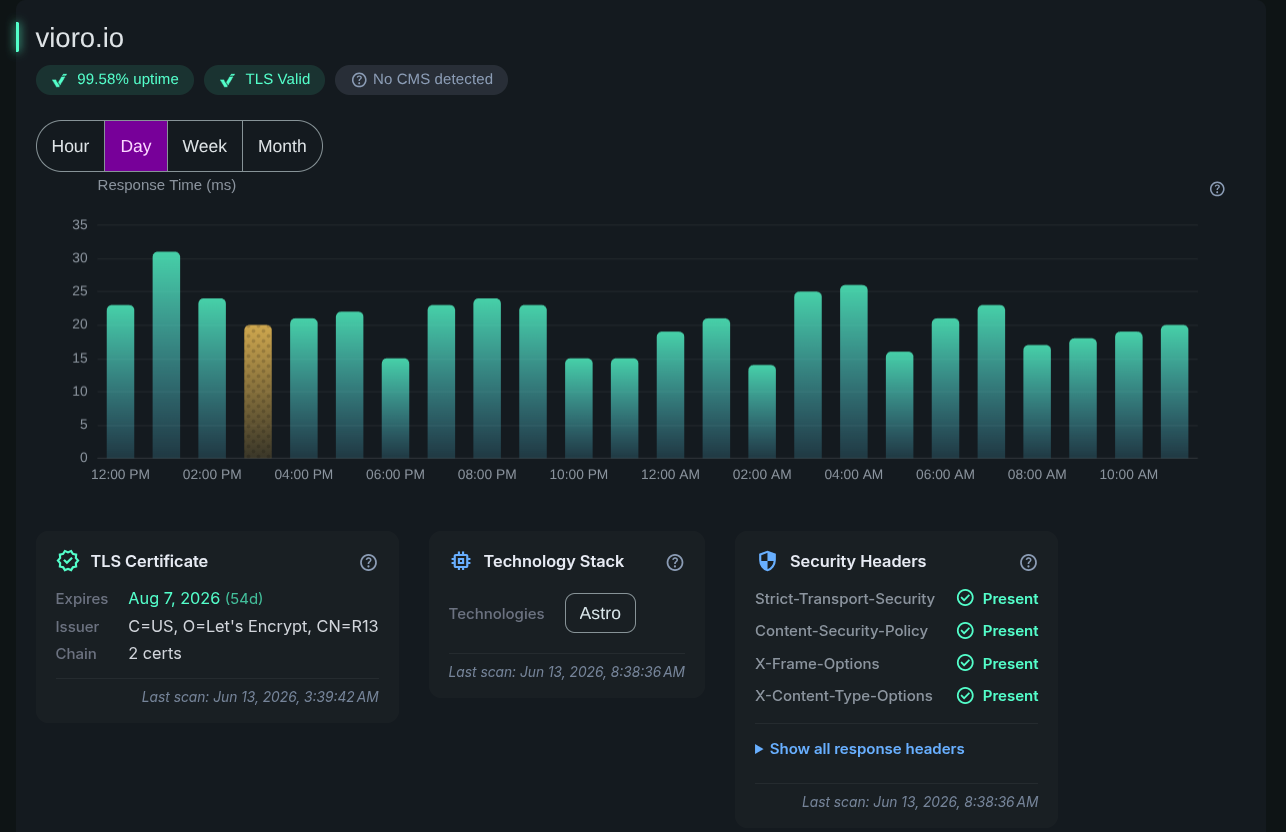
Continuously monitors live HTTPS availability and response latency around the clock from 100% EU-hosted infrastructure.

Severity: Critical Cadence: By Plan

Scheduled HTTPS Availability Probing

Checks live website availability around the clock from EU infrastructure at intervals determined by your plan tier.

Uptime & SLA calculation
Severity: High Cadence: By Plan

3-Consecutive-Failure Anti-Flap Alerting & Recovery

Requires 3 consecutive failed availability checks before triggering an outage alert, eliminating false-positive noise and sending automatic recovery notices.

Severity: Info Cadence: By Plan

Response-Time Tracking & Failure Classification

Measures millisecond response latency trends across 24-hour, 7-day, and 30-day windows while classifying HTTP non-2xx responses and timeouts.

See what your website exposes today

Run a free instant check on any public URL to spot exposed versions, missing security headers, and certificate risks.

Start Continuous Website Monitoring in 60 Seconds

Monitor live JavaScript vulnerabilities, leaked API keys, TLS certificates, HTTP security headers, CMS exposures, and uptime around the clock from EU infrastructure.

14-day free trial • 100% EU-hosted • No server agents or repository access